
Software Architecture for HFT EA: High Frequency Expert Advisors for MT4 & MT5 Platforms
Deploying automated software for hft ea requires bypassing the conventional performance limitations of standard retail platforms. MetaTrader 4 and MetaTrader 5 are designed primarily for discretionary traders and standard indicators, processing incoming ticks sequentially on single-threaded event loops. When high market volatility strikes, this architecture creates severe queue bottlenecks.
High-performance expert advisors overcome this limitation by operating external execution engines. By reading quotes directly through native Windows shared memory (RAM) or direct inter-process sockets, the system evaluates trading criteria within microseconds. Studying hft trading ea illustrates how external feed bridges communicate with client terminals without inducing execution freezing.
Asynchronous Order Execution & Bridge Optimization
In classical Expert Advisor scripting, calling an order dispatch command blocks the execution thread until the broker server returns a confirmation receipt-a round-trip delay that routinely exceeds 80 to 250 milliseconds. In hft forex ea, blocking execution is fatal because dozens of subsequent price updates are missed during the wait state.
Modern low-latency software employs asynchronous non-blocking order dispatching (such as OrderSendAsync in MT5 or direct FIX 4.4 order routing). Outbound orders are transmitted immediately into network sockets, while fill notifications are handled by background callback threads. Implementing best high frequency trading software ensures the trading engine maintains continuous price telemetry across all monitored instruments.
Reddit & MQL5 Community Software Realities
Community Reviews: MQL5 Forum & Reddit Algorithmic Hubs
Technical reviews across the MQL5 Community and Reddit's r/algotrading emphasize core truths regarding high-frequency bots and commercial software:
- The Danger of Pirated & Cracked EAs: Community members repeatedly document that cracked copies of high-frequency trading bots circulating on Telegram and underground forums are stripped of their server authentication layers. Without connection to the proprietary low-latency feed cluster, the software cannot detect price leads and generates catastrophic losing trades.
- Tick Replay vs Visual Backtesting: Standard MT4 backtesting uses interpolated ticks that simulate smooth price movement. Real high-frequency opportunities exist in microsecond jagged price jumps that only true tick-by-tick market recorders can capture accurately.
- Memory Leak Precautions: Commercial bots running continuous sub-second loops must feature optimized memory management. Poorly compiled DLLs cause terminal crashes during major news events like US Non-Farm Payrolls.
Technical Specifications & Comparative Matrix
Quantitative benchmarks defining operational parameters for hft ea across industry venues and architectures:
| Platform / Engine Architecture | Internal Tick Dispatch Speed | Order Sending Model | Suitable Trading Style |
|---|---|---|---|
| Direct FIX API / C++ Standalone Engine | < 50 microseconds | Async Non-Blocking FIX 4.4 Socket | Ultra-Low Latency Arbitrage & Market Making |
| MetaTrader 5 with C++ DLL Bridge | 0.8 - 1.8 milliseconds | OrderSendAsync Multi-Threaded | Fast Tick Scalping & Multi-Pair Arbitrage |
| MetaTrader 4 with Shared Memory Bridge | 2.5 - 6.0 milliseconds | Native DLL Injected Dispatch | Fast Scalping & Latency Impulses |
| Standard MQL4 Internal Script (No DLL) | 25 - 80 milliseconds | Synchronous Blocking OrderSend | Traditional Indicator & Trend Strategies Only |
Implementation Protocol & Risk Control
Deploying automated execution for hft ea requires a disciplined four-stage operational workflow:
1. Infrastructure & Colocation Setup
Establish your server inside the primary financial data center (Equinix LD4 or NY4) matching your broker's trade execution server. Audit ping stability to eliminate packet jitter.
2. Fast Market Data Calibration
Integrate a verified institutional fast price feed (such as LMAX or Rithmic). Ensure tick timestamp synchronization matches UTC atomic clock standards with microsecond precision.
3. Gateway & Bridge Optimization
Deploy native C++ DLL memory hooks or direct FIX 4.4 API order gateways. Configure hard slippage ceilings and spread filters to reject fills during illiquid spread widening.
4. Post-Trade Mark-Out Telemetry
Log every trade execution round-trip. Measure mark-out profitability at 100ms, 1 second, and 5 seconds post-fill to verify that your broker provides genuine A-book execution.
Westernpips Private 7: Low-Latency Precision Engine
Westernpips has pioneered latency arbitrage and high-frequency trading technology since 2007. Private 7 connects to ultra-fast feeds and executes orders via FIX API and low-level bridges with sub-millisecond accuracy.
Explore Westernpips Private 7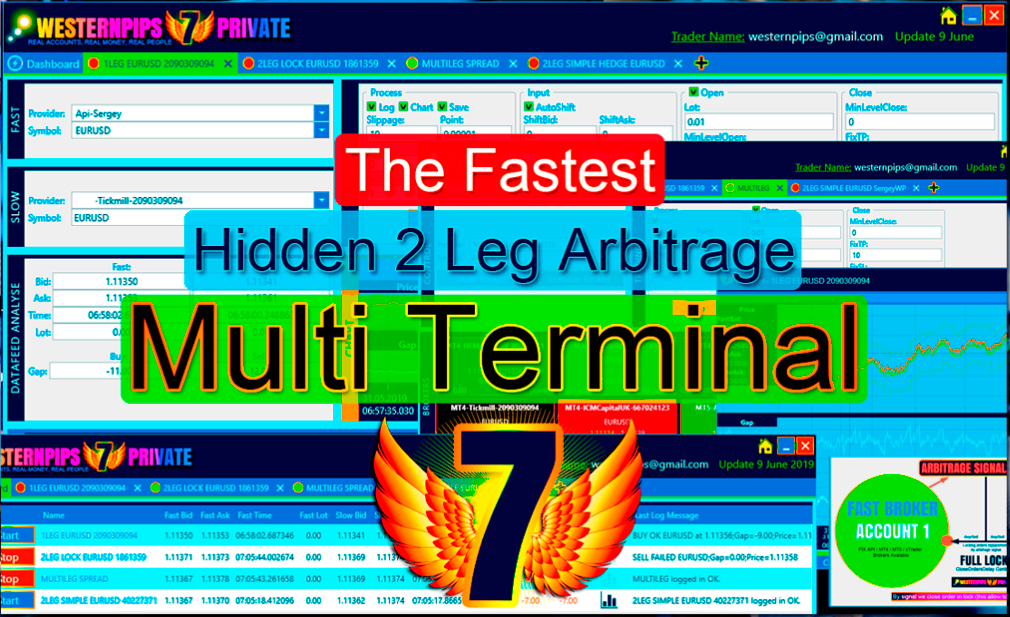
Frequently Asked Questions
How does an HFT bot communicate with a MetaTrader terminal?
Professional HFT bots operate an external high-speed daemon that connects directly to institutional market data feeds. When a trade condition occurs, the daemon passes the order payload into the MetaTrader terminal via C++ memory mapping or direct DLL hooks.
Can hft ea be backtested in the MT4 Strategy Tester?
Standard MT4 Strategy Tester cannot accurately backtest latency strategies because it simulates artificial price movement and assumes instantaneous zero-latency fills. Accurate testing requires recorded live tick streams with measured real-world broker execution slippage.
What makes Westernpips Private 7 unique compared to basic EAs?
Westernpips Private 7 is a comprehensive software platform connecting simultaneously to multi-asset institutional feeds (LMAX, Rithmic, CQG, Saxo, Binance) and routing execution through direct FIX API or optimized terminal bridges with sub-millisecond precision.
Related Knowledge Base & Guides
Expand your research into related execution mechanics, algorithmic frameworks, and broker policies: