
Execution Rules & Architecture for HFT Trading Computers: Overclocked CPUs, Solarflare NICs & Kernel Bypass
The prop trading ecosystem has undergone rapid structural transformation, making high frequency trading computers a focal point of debate among traders and prop firm operators. Proprietary trading firms offering evaluation challenges typically route simulated challenge accounts through demo servers with idealized execution parameters: zero slippage, immediate virtual fills, and tight simulated spreads.
Traders deploying high-frequency strategies to pass evaluation challenges capitalize on this simulated execution speed. Understanding high frequency day trading clarifies why certain firms explicitly welcome HFT bots during Phase 1 and Phase 2 challenges, while enforcing strict holding time and risk rules once traders transition to live funded accounts.
A-Book vs B-Book Broker Execution Reality
When selecting brokers or prop firms for hft computer, execution routing is the single defining variable. A-book brokers and institutional prime brokers pass customer orders directly through to external bank liquidity providers via FIX bridges. On these venues, high-frequency flow is welcomed because the broker earns a net commission on every trade regardless of profitability.
In contrast, B-book retail brokers act as the direct counterparty to client trades. On B-book platforms, latency scalpers represent a direct financial loss. Consequently, B-book brokers configure virtual dealer plugins that delay order execution by 150ms to 400ms during market spikes, generating severe negative slippage. Referencing robinhood hft helps identify trading conditions that support low-latency algorithmic trading.
Reddit r/propfirm & Trader Community Reports
Community Consensus: Reddit r/propfirm & Discord Case Studies
Discussions among prop firm traders on r/propfirm and trader Discord servers highlight critical lessons for automated algorithmic trading:
- The Challenge Pass vs Payout Paradox: While hundreds of traders successfully pass 100k and 200k prop firm challenges using HFT bots in under 2 hours, many face payout denials if they fail to read the fine print. Prop firms that allow HFT passing frequently ban HFT on the funded stage or impose 1-minute to 2-minute holding time consistency rules.
- Server Colocation Advantage: Traders operating from home connections experience frequent challenge failures due to packet loss during economic releases. Renting an Equinix LD4 or NY4 VPS with sub-millisecond proximity is considered standard operating procedure.
- Tick Volume Flagging: Modern prop firms utilize automated risk engines that flag accounts executing more than 50 orders per minute, categorizing the behavior as server abuse unless pre-cleared by the firm.
Technical Specifications & Comparative Matrix
Quantitative benchmarks defining operational parameters for high frequency trading computers across industry venues and architectures:
| Prop Firm / Broker Category | Challenge HFT Policy | Funded Stage Restrictions | Average Payout Reliability |
|---|---|---|---|
| HFT-Friendly Prop Firms (Challenge Only) | Permitted (EAs Allowed) | Manual / Swing Rules Enforced (Min 1-2 min) | High (if funded rules strictly observed) |
| Strict Traditional Prop Firms (e.g. FTMO) | Strictly Prohibited | Latency Arbitrage & Tick Scalping Banned | Very High (for discretionary & swing EAs) |
| Institutional Direct DMA / FIX Brokers | Allowed (Full API Access) | Zero Holding Time Restrictions (Pure A-Book) | Tier-1 Direct Bank Deposit Fills |
| Standard Retail B-Book Brokers | Often Restricted | Virtual Dealer Slippage Applied (> 150 ms) | Low for Latency Strategies |
Implementation Protocol & Risk Control
Deploying automated execution for high frequency trading computers requires a disciplined four-stage operational workflow:
1. Infrastructure & Colocation Setup
Establish your server inside the primary financial data center (Equinix LD4 or NY4) matching your broker's trade execution server. Audit ping stability to eliminate packet jitter.
2. Fast Market Data Calibration
Integrate a verified institutional fast price feed (such as LMAX or Rithmic). Ensure tick timestamp synchronization matches UTC atomic clock standards with microsecond precision.
3. Gateway & Bridge Optimization
Deploy native C++ DLL memory hooks or direct FIX 4.4 API order gateways. Configure hard slippage ceilings and spread filters to reject fills during illiquid spread widening.
4. Post-Trade Mark-Out Telemetry
Log every trade execution round-trip. Measure mark-out profitability at 100ms, 1 second, and 5 seconds post-fill to verify that your broker provides genuine A-book execution.
Westernpips Private 7: Low-Latency Precision Engine
Westernpips has pioneered latency arbitrage and high-frequency trading technology since 2007. Private 7 connects to ultra-fast feeds and executes orders via FIX API and low-level bridges with sub-millisecond accuracy.
Explore Westernpips Private 7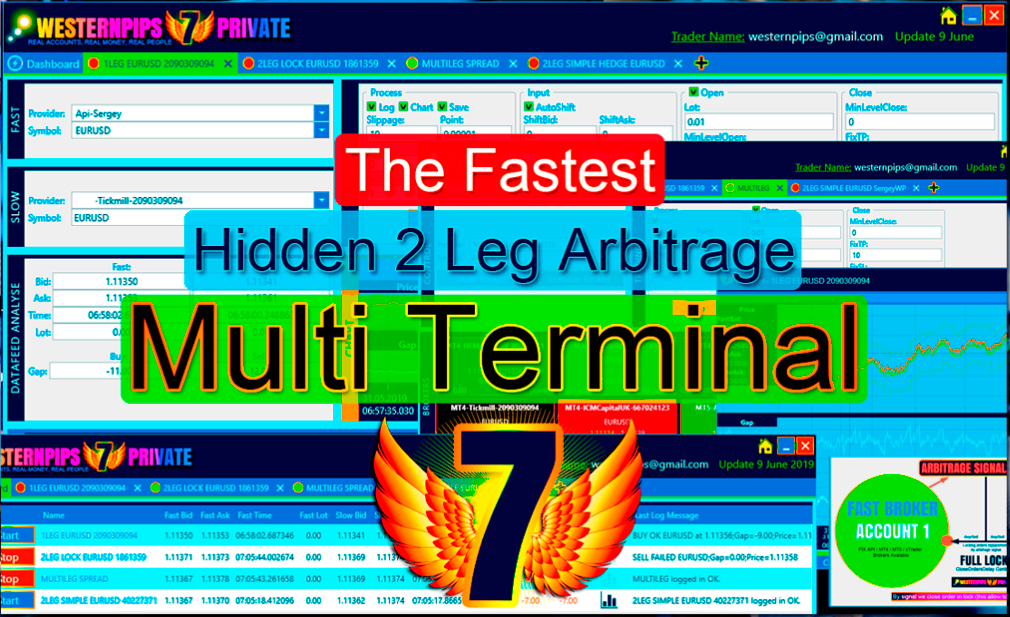
Frequently Asked Questions
Which prop firms allow high frequency trading computers in 2026?
Multiple prop firms permit HFT bots specifically for passing evaluation stages, capitalizing on challenge fee models. However, traders must transition to rule-compliant manual or automated strategies on funded accounts to secure regular profit splits.
Why do strict prop firms like FTMO ban high frequency trading computers?
Firms like FTMO copy funded trader orders to live liquidity providers. Because latency arbitrage exploits demo server quote delays that do not exist on real interbank feeds, those orders cannot be hedged profitably in live institutional markets.
How do I ensure optimal VPS connection to my broker server?
Locate the broker's live trade server IP address using terminal network diagnostics, determine the data center facility (typically Equinix LD4 in London or NY4 in New Jersey), and deploy a VPS hosted in the identical physical facility.
Related Knowledge Base & Guides
Expand your research into related execution mechanics, algorithmic frameworks, and broker policies: