
High-Frequency Trading & Latency Arbitrage Hub • 100 Research Guides
HFT Trading & Execution Architecture
Explore 100 specialized technical guides detailing high-frequency trading microstructure, sub-millisecond latency arbitrage, prop firm evaluation pass rules, algorithmic coding in Python & C++, and institutional technology.
Comprehensive 100-Topic Architecture
Direct links to 8 specialized research domains covering every aspect of high-speed trading:
How High-Frequency Trading Operates
High-frequency trading automates a repeated cycle of market-data processing, trading decisions and order management. In an order-book strategy, this cycle connects incoming quotes and trades with the algorithm's current positions and risk limits. For example, a change in the available bid or ask can trigger a quote update, an order cancellation or a new order, depending on the strategy. To understand an HFT system, follow the complete path from the market event to the resulting order rather than judging it by speed alone.
Latency arbitrage is one application of fast market-data comparison, rather than a definition of all HFT. In Forex and CFD setups, an algorithm compares a reference feed with the prices available on its trading connection. For example, a difference between those quotes may trigger an order, but the requested price can change or be rejected before execution. Evaluate the opportunity using actual fills, slippage and trading costs, not the displayed price gap alone.
Read Core HFT Guide →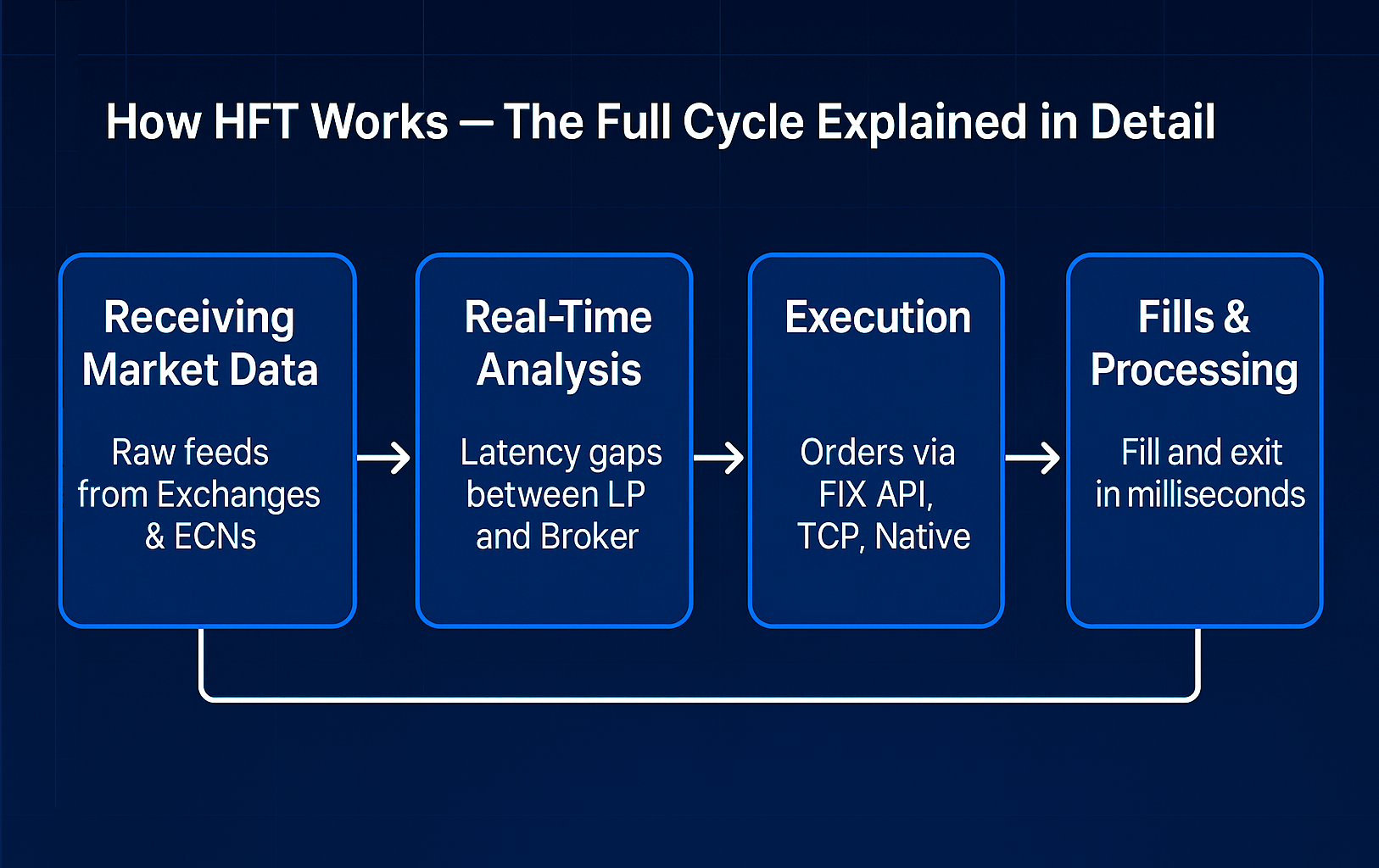
Colocation & Low-Latency Network Paths
Colocation can reduce the network distance between a trading system and its connected venue. The relevant location depends on the actual market-data and order-entry endpoints, not simply the city or data-center brand. A server near the feed endpoint may still take a different route to the execution gateway, so proximity alone does not describe the complete order path. Compare both routes and measure their latency before selecting a hosting location.
Low-latency infrastructure should address the bottleneck in the specific trading setup. Depending on the architecture, the delay may come from network routing, application processing, operating-system scheduling or the remote gateway. For example, faster local processing cannot remove a delay introduced after an order reaches an external server. Measure the stages separately and choose hardware or connectivity changes that address the observed delay.
Explore Latency Benchmarks →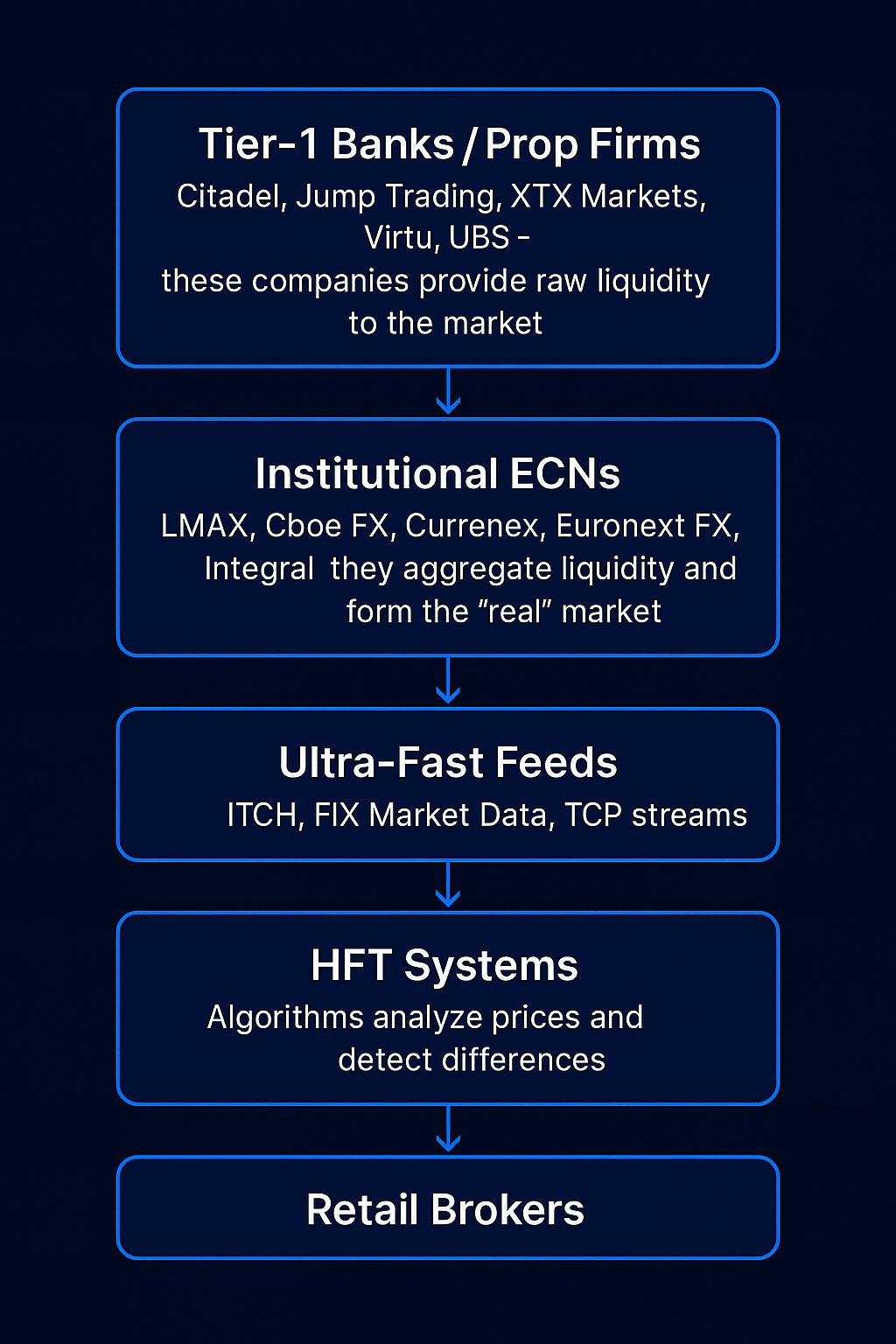
Directory of 100 Technical HFT Guides
Explore our complete network of 100 research articles, covering all 275 keywords with dedicated technical analysis, forum insights, and quantitative specifications:
Core HFT Research (15 Guides)
↑ Back to CategoriesHFT Trading Explained: Mechanics, Speed & Microstructure
Complete guide to HFT Trading: how high frequency trading systems use sub-millisecond market data, colocation, and low-latency execution loops.
HFT Meaning & Definition: What High-Frequency Trading Really Is
Explore the exact HFT meaning and definition: automated execution speed, order-book dynamics, and why microseconds determine trading edge.
High Frequency Trading Explained: Liquidity, Colocation & Algorithms
High frequency trading explained clearly: how algorithmic desks interact with matching engines, liquidity pools, and tick-by-tick market data.
Understanding High Frequency Trading: Real-World Architecture
A practical guide to understanding high frequency trading: from institutional order routers to retail latency arbitrage realities.
High Frequency Trading for Beginners: Realistic Pathways & Requirements
High frequency trading for beginners: foundational math, programming, server infrastructure, and realistic retail vs institutional barriers.
High Speed Trading & Frequency Trading: Microsecond Order Loops
Inside high speed trading: how frequency trading algorithms ingest tick data, process market signals, and submit orders in under a millisecond.
HFT Latency & Execution Speed: Sub-Millisecond Benchmarks
HFT latency and execution speed explained: network propagation, fiber optics vs microwave links, kernel bypass, and sub-millisecond targets.
Low Latency & Ultra High Frequency Trading: Microwave & Kernel Bypass
Low latency and ultra high frequency trading engineering: FPGA hardware acceleration, Solarflare Onload network stacks, and microwave routes.
Types of High Frequency Trading: Market Making to Statistical Inefficiencies
Discover all types of high frequency trading: market making, latency arbitrage, order-book imbalance, and statistical microstructure strategies.
HFT Market Microstructure: Order Books, Queue Priority & Depth
How the high frequency trading market operates: limit order book dynamics, queue position priority, spread capture, and institutional liquidity.
Dark Pools & High Frequency Trading: Institutional Flow & Crossing Networks
Dark pools and high frequency trading: how off-exchange crossing networks interact with retail liquidity providers and HFT market makers.
HFT Spoofing & Layering: Mechanics, Detection & Enforcement
HFT spoofing and layering explained: fake phantom orders, regulatory detection algorithms, legal consequences, and market integrity.
VPIN Toxicity & HFT Controversies: Why Regulators Scrutinize Speed
VPIN toxicity metrics and HFT controversies: measuring toxic order flow, flash crash dynamics, and debates over banning high frequency trading.
HFT Regulations: SEC Rule 15c3-5, Market Access & ASIC Compliance
Regulatory landscape for high frequency trading: SEC Rule 15c3-5 market access controls, MiFID II algorithmic auditing, and ASIC monitoring.
High Frequency Trading: Market Realities, Evolution & Future
The new realities of automated high frequency trading: technological arms race, margin compression, and institutional liquidity standards.
Arbitrage Research (17 Guides)
↑ Back to CategoriesHFT Arbitrage Trading: Exploiting Inter-Exchange Latency Gaps
HFT arbitrage trading guide: how fast price feeds detect stale quotes on retail venues and execute profitable millisecond trades.
Latency Arbitrage Forex: Fast Feed Comparison & Millisecond Execution
Latency arbitrage in forex explained: comparing institutional feeds against retail MT4 brokers, slippage buffers, and execution requirements.
Latency Arbitrage EA: Architecture, Feed Bridge & Execution Speed
Latency arbitrage EA mechanics: shared memory bridges, tick comparison algorithms, and why free download EAs usually fail on live spreads.
HFT Arbitrage EA Free Downloads: Real Risks, Trojanned DLLs & Tests
The truth about free download HFT arbitrage EAs: malicious DLLs, outdated price feed servers, and why legitimate arbitrage requires server infrastructure.
Forex Arbitrage Trading Strategies: Two-Leg, Triangular & Statistical
Forex arbitrage trading strategies analyzed: two-leg latency arbitrage, triangular currency cross gaps, and statistical spread trading.
Arbitrage in Foreign Exchange Market: Math, Flow & Live Examples
Practical guide to arbitrage in foreign exchange market: numerical examples, order book discrepancies, and currency cross-rate mechanics.
Arbitrage in Forex Market: How Discrepancies Arise Across Liquidity Pools
Explore the meaning of arbitrage in forex market: decentralized liquidity providers, quote aggregation latency, and order fill realities.
Forex Arbitrage Opportunities: Real-Time Scanning & Slippage Thresholds
How to find forex arbitrage opportunities in 2026: real-time tick scanners, spread considerations, and broker execution latency monitoring.
Currency Arbitrage: Cross-Currency Matrix & Price Inconsistencies
Currency arbitrage explained: mathematical parity across currency pairs, cross-rate calculation matrices, and execution speed requirements.
Forex Triangular Arbitrage: Three-Leg Synthetic Discrepancy & Spread Drag
Forex triangular arbitrage and triangular EAs: trading EUR/USD, GBP/USD, and EUR/GBP loops, spread drag, and commission hurdles.
Forex Swap & Forward Arbitrage: Covered Interest Parity & Rollover
Forex swap arbitrage and forward arbitrage: exploiting interest rate differentials, rollover fee variances, and institutional forward curves.
Forex Statistical Arbitrage: Cointegration, Mean Reversion & Pairs Trading
Forex statistical arbitrage and high frequency pairs trading: cointegration models, long/short dollar neutrality, and algorithmic mean reversion.
Reverse Arbitrage Trading Forex: Hedging Fast Legs on Slower Venues
Reverse arbitrage trading in forex: opening positions on slow brokers and closing on fast market signals to mask toxic latency flow.
BJF Trading & PZ Arbitrage EA Review: Latency Software Comparison
Review of BJF Trading and PZ Arbitrage EA: performance benchmarks, tick feed speed, broker compatibility, and software comparison.
Forex Arbitrage on Reddit & Forex Factory: What Forum Traders Report
Real-world findings on forex arbitrage from Reddit r/Forex and Forex Factory: broker accounts cancelled, slippage plugins, and viable setups.
Arbitrage EA MT4: Bridge DLLs, Virtual Terminal Speed & Execution
Arbitrage EA MT4 technical guide: MQL4 execution constraints, native C++ DLL bridges, Windows shared memory, and virtual terminal optimizations.
Arbitrage EA Forex: Automated Latency Detection on MetaTrader
How an arbitrage EA operates on forex brokers: trigger thresholds, spread filters, maximum slippage protection, and real-time feed logging.
Prop Firms & Brokers Research (12 Guides)
↑ Back to CategoriesProp Firms That Allow HFT: Passing Rules, Challenge Limits & Payouts
Prop firms that allow HFT EAs in 2026: rules for evaluation challenges, funded phase holding times, slippage policies, and payout terms.
FTMO HFT Rules: Why Latency Arbitrage & Tick Scalping Are Prohibited
Analysis of FTMO HFT rules: why latency arbitrage, tick scalping, and ultra-fast bots are banned, and how toxic flow detection works.
HFT Brokers: Low Latency Spreads, Direct Market Access & Execution
Selecting HFT brokers: genuine A-book execution, raw institutional spreads, FIX API availability, and colocation in Equinix LD4/NY4.
Forex Brokers That Allow Arbitrage: A-Book vs B-Book Execution Reality
The reality of forex brokers that allow arbitrage: why B-book brokers reject fast flow, while institutional prime-of-primes allow latency strategies.
Interactive Brokers HFT: FIX CTCI, Direct Routing & API Performance
Interactive Brokers high frequency trading capabilities: FIX CTCI protocol, direct market routing, execution latency benchmarks, and costs.
Dukascopy, Exness & OctaFX Arbitrage: JForex API vs Retail Execution
Execution analysis of Dukascopy, Exness, and OctaFX: JForex API speeds, retail mark-up delays, and latency arbitrage viability.
High Frequency Trading at Home: Colocated VPS vs Local Retail Internet
Can you run high frequency trading at home? Network latency realities, why local home internet loses 50-100ms, and how VPS colocation helps.
High Frequency Trading for Retail Investors: Boundaries & Practical Edge
HFT for retail investors: practical boundaries, achievable latency edges, software requirements, and avoiding common marketing scams.
HFT Trading Computers: Overclocked CPUs, Solarflare NICs & Kernel Bypass
HFT trading computers and hardware specs: liquid-cooled 5.8GHz+ CPUs, PCIe FPGA boards, Solarflare NICs, and enterprise rack servers.
High Frequency Trading on Reddit: r/algotrading & r/quant Discussions
High frequency trading discussions on Reddit r/algotrading, r/quant, and r/Forex: community consensus on retail HFT, prop firms, and careers.
Robinhood & HFT: Payment for Order Flow (PFOF) & Cloud Architecture
Robinhood and HFT: how retail orders are routed to market makers under PFOF, and how cloud infrastructure differs from bare-metal colocation.
High Frequency Day Trading: Sub-Second Scalping vs Manual Day Trading
High frequency day trading in stocks: differences between sub-second algorithmic execution and discretionary intraday scalping.
Bots & Software Research (14 Guides)
↑ Back to CategoriesHFT Software Solutions: Feed Ingestion, Execution Engines & Gateways
Overview of HFT software: tick ingestion engines, FIX API order gateways, latency calculation matrices, and enterprise connectivity.
Best High Frequency Trading Software: Architecture, Costs & Benchmarks
Reviewing the best high frequency trading software: Westernpips Private 7, institutional gateways, low-latency API performance, and licensing.
HFT EA: High Frequency Expert Advisors for MT4 & MT5 Platforms
HFT EA architecture: how high frequency expert advisors operate on MetaTrader terminals, bypassing standard tick loops via external feed bridges.
High Frequency Trading EA: Millisecond Tick Triggering & Latency Guards
Building and operating a high frequency trading expert advisor: millisecond latency guards, dynamic slippage limits, and execution logging.
HFT EA MT4: Bypassing Client Terminal Bottlenecks with Native DLLs
HFT EA MT4 optimizations: overcoming MetaTrader 4 single-threaded architecture with external C++ shared memory and direct order injection.
High Frequency Trading on MT4: Terminal Latency Limits & Solutions
High frequency trading on MT4: understanding terminal-level delays, server ping vs execution ping, and modern low-latency alternatives.
HFT EA MT5: Asynchronous Orders, Multi-Threading & Tick Processing
HFT EA MT5 advantages: native asynchronous order routing (OrderSendAsync), millisecond timers, and institutional market depth (DOM).
HFT Robot Forex: Automated Tick Scalping & Price Inefficiency Harvesters
HFT robot forex systems: automated tick scalpers, micro-gap detectors, and how to verify real forward execution logs vs fake backtests.
Fast Scalper EA: Millisecond Take-Profit Targets & Broker Detection
High frequency fast scalper EA mechanics: sub-pip take-profit targets, holding times under 1 second, and avoiding broker toxic flow flags.
Fondex HFT EA & v3.0: High-Frequency Bot Analysis & Performance Tests
Analysis of Fondex HFT EA and v3.0: evaluating tick-scalping claims, execution performance on cTrader and MT4, and user reviews.
FX HFT Pro v14.1 EA: Automated Forex High-Frequency Engine Review
Technical review of FX HFT Pro v14.1 EA and personal algorithmic EAs: order execution mechanics, risk parameters, and live trading risks.
EA HFT Secret & Russian Bear HFT: Historical Forensics & Community Trials
Forensic review of EA HFT Secret and Russian Bear HFT: analyzing historical forum claims, marketing hype, and actual execution results.
MetaTrader Arbitrage Systems: Fast Feed Integration via Shared Memory
Implementing MetaTrader arbitrage systems: connecting fast external price feeds to MT4/MT5 using shared RAM memory and low-latency sockets.
HFT Trading EA Mechanics: Low-Level Architecture & Tick Buffers
Inside HFT trading EA mechanics: ring buffers, tick queue processing, async thread dispatching, and sub-millisecond execution loops.
Algo & Coding Research (13 Guides)
↑ Back to CategoriesHFT Trading Systems Architecture: End-to-End Tick-to-Trade Pipeline
Architecture of institutional HFT trading systems: market data parsing, order book building, algorithmic state machines, and order gateways.
High Frequency Trading Algorithm Design: State Machines & Queue Logic
High frequency trading algorithm design: deterministic state machines, queue position logic, order cancel-replace loops, and safety stops.
HFT Algo Trading: Tactical Microstructure Signals & Order Routing
Tactical HFT algo trading strategies: order book imbalance (OBI), micro-price calculation, trade volume synchronization, and smart routing.
HFT Algorithm Examples: Order Book Imbalance, Latency Sniping & Hedging
Concrete HFT algorithm examples: latency sniping pseudocode, order book depth imbalance triggers, and delta-hedging execution pipelines.
Algorithmic & High Frequency Trading: Execution Horizons & Systemic Edges
Differentiating algorithmic trading and high frequency trading: execution time horizons, hardware dependencies, and alpha decay dynamics.
High Frequency Trading in Python: Asyncio, Cython & WebSocket Feed Engines
High frequency trading in Python: building ultra-fast WebSocket parsers with uvloop, compiling bottlenecks in Cython, and C++ extensions.
Python HFT Trading: Low-Latency Libraries, Numba & PyPy Benchmarks
Benchmark Python for HFT: comparing CPython, PyPy, Numba JIT compilation, and high-performance libraries like Polars and QuickFIX.
Open Source High Frequency Trading: Modular Frameworks & Community Engines
Open source high frequency trading engines: NautilusTrader, Roq, CCXT low-latency branches, and modular C++ microstructure libraries.
HFT GitHub Repositories: Curated Codebases, L2 Order Books & Backtesters
Top HFT GitHub repositories reviewed: high-speed order book implementations, ITCH feed parsers, tick-level backtesters, and FIX engines.
High Frequency Quantitative Trading: Probability Theory & Poisson Models
Quantitative models in HFT: Hawkes processes for order arrival, Poisson jump intensity, stochastic spread dynamics, and probability theory.
HFT Models & DIY System Development: Building an In-House Trading Rig
DIY high frequency trading systems: architecture blueprint, feed ingestion, message queues, risk checks, and development pitfalls.
High Frequency Option Trading: Microsecond Greeks & Volatility Arbitrage
High frequency option trading: real-time Black-Scholes Greeks calculation, automated volatility surface fitting, and cross-venue arbitrage.
Nanex & Tabb Group HFT Research: High-Resolution Market Data Audits
Historic market data findings by Nanex and Tabb Group: sub-millisecond quote stuffing, microsecond order cancellations, and exchange feeds.
Markets Research (11 Guides)
↑ Back to CategoriesHFT Forex Trading: Institutional ECN Feeds vs Slower Broker Streams
HFT forex trading guide: LMAX, Currenex, and EBS institutional market data compared against retail broker latency and execution buffers.
High Frequency Currency Trading: Liquidity Aggregation & FIX Gateways
High frequency currency trading mechanics: liquidity aggregators (OneZero, PrimeXM), FIX 4.4 protocol, and Equinix LD4 colocation.
High Frequency Trading in Crypto: Cross-Exchange Arbitrage & WebSocket APIs
HFT in cryptocurrency markets: cross-exchange order book latency, maker fee rebate farming, colocation in AWS Tokyo, and WebSocket streams.
HFT on Binance: VIP Fee Tiers, Colocation & WebSocket Streams
HFT trading on Binance: VIP fee structures, negative maker fees, Binance WebSocket API rate limits, and Tokyo AWS server proximity.
Bybit & Emerging Venues: Sub-Millisecond Crypto & Cross-Border Latency
HFT on Bybit and emerging global exchanges like Brazil B3: API throughput, server colocation, and sub-millisecond execution opportunities.
HFT Stock Trading: Direct Exchange Feeds, Reg NMS & SIP Delays
HFT in stock markets: Direct feeds (NASDAQ TotalView, NYSE Integrated) vs SIP delays, Reg NMS order protection, and sub-penny pricing.
High Frequency Stock Trading: Colocated Matching Engines at Equinix NY4
Equinix NY4 stock trading mechanics: direct cross-connects, matching engine queue priorities, and high speed proprietary trading shops.
HFT Futures Trading: CME Aurora Colocation & ITCH/OUCH Order Routing
HFT futures trading on CME: Aurora data center colocation, CME MDP 3.0 market data, SBE encoding, and ultra-fast futures execution.
HFT Funds: How Market-Making Desks Deploy Algorithmic Capital
Inside institutional HFT funds: risk allocation, Sharpe ratios above 4.0, zero-overnight holding strategies, and capital efficiency.
High Speed Trading Shops: Proprietary Desks, Infrastructure & Margins
How high frequency trading shops operate: private proprietary trading firms, technological infrastructure, and shrinking margins in 2026.
High Frequency Trading Companies: Global Market Participants
Global overview of high frequency trading companies: market share in US equities, European futures, Asian currencies, and crypto.
Firms Research (12 Guides)
↑ Back to CategoriesHigh Frequency Trading Firms: Top Global Players, Volume & Operations
Comprehensive review of global HFT firms: how proprietary trading giants capture liquidity, deploy billions, and compete in microseconds.
Top 10 High Frequency Trading Firms: Global Market Makers Ranked
Top 10 high frequency trading firms ranked: Citadel Securities, Virtu, Jump Trading, Jane Street, Optiver, and HRT operations analyzed.
Top HFT Firms Performance & Historical Shifts: 2020 to 2026 Analysis
Historical performance and technological shifts among top HFT firms from 2020 to 2026: volatility spikes, revenue trends, and growth.
Best HFT Companies: Market Share, Liquidity Provision & Technology Stacks
Evaluating the best HFT companies: technology stacks, hiring standards, low-latency C++ infrastructure, and proprietary algorithms.
Top HFT Firms Industry Overview: Proprietary Trading & Market Making
Industry analysis of top HFT firms, including Asian powerhouses like AlphaGrep, Graviton, and global proprietary desks.
Citadel Securities HFT: Market Making Architecture, PFOF & Speed
Inside Citadel Securities HFT: retail order internalization, exchange market making, proprietary low-latency network, and scale.
Virtu Financial HFT: Multi-Asset Market Making & Bid-Ask Economics
Virtu Financial HFT breakdown: POSIT dark pool, global exchange connectivity, bid-ask spread capture, and publicly audited performance.
Jane Street, Two Sigma & Tower Research: Quantitative Desks & Infrastructure
Comparing Jane Street, Two Sigma, and Tower Research: OCaml and C++ stacks, ETF arbitrage, statistical modeling, and low latency.
Optiver & DRW HFT: Market Making in Derivatives & High-Speed Arbitrage
Optiver and DRW high frequency trading profiles: options market making, automated volatility quoting, and proprietary technology.
IMC & HRT: Automated High-Speed Trading Engineering & Global Desks
IMC Trading and Hudson River Trading (HRT) deep dive: algorithmic research culture, custom hardware engineering, and global trading desks.
GETCO to KCG: The History of High Frequency Trading Pioneer Desks
The pioneering era of GETCO and KCG: early high frequency trading algorithms, the 2012 software glitch, and the evolution of electronic markets.
Goldman Sachs, Morgan Stanley & UBS: How Investment Banks Use HFT
How major investment banks deploy HFT: client facilitation desks, internal crossing engines, smart order routers, and liquidity dark pools.
Westernpips Research (6 Guides)
↑ Back to CategoriesWesternpips Private 7: Ultra-Low-Latency Arbitrage & FIX API Software
Westernpips Private 7 official overview: low-latency arbitrage software connecting fast LMAX/Rithmic/CQG feeds to MetaTrader and FIX brokers.
Westernpips Official Platform: 19+ Years of Latency Trading Technology
Explore Westernpips com and HFT technology: since 2007 developing ultra-fast price feed aggregators, arbitrage engines, and trading software.
Westernpips Download: Fast Feed Setup, Terminal Bridges & Configuration
Westernpips Private 7 download and setup guide: installing fast data server bridges, configuring MetaTrader advisors, and latency testing.
Westernpips Cracked & Free Downloads: Security Analysis & Broken Feeds
Security analysis of cracked Westernpips software and free downloads: why pirated DLLs fail without server data feeds and expose account keys.
Westernpips Scam Reviews & Myfxbook: Real Forward Tests vs B-Book Brokers
Westernpips scam accusations vs verified forward tests on Myfxbook: understanding why B-book broker slippage causes losses, not the software.
Westernpips 7 Performance & Setup: Low-Latency Execution Benchmarks
Westernpips 7 execution benchmarks: server latency audits, multi-broker order routing, spread filtering, and sub-millisecond execution logs.
High-Frequency Trading on Video
The Wall Street Code
The landmark documentary profiling quantitative developers and algorithmic engineers who turned financial markets into an ultra-low-latency arms race.
Setup, Menus & Latency Strategies
Technical walkthrough illustrating how high-frequency trading software is installed, connected to fast feed servers, and configured for live trading.
Frequently Asked Questions
What is HFT trading?
HFT stands for high-frequency trading, a form of automated trading focused on short decision and execution times. Its operation depends on the strategy, market structure and access to data and order-entry services. For example, an automated quoting strategy can update or cancel orders as the order book changes, while an arbitrage strategy compares related prices. Start by identifying the strategy and its execution requirements before comparing software or infrastructure.
Is HFT trading legal?
The legal assessment of an HFT setup depends on its conduct and the rules that apply to it. Relevant conditions include the jurisdiction, venue requirements and the broker or platform agreement. For example, a strategy permitted by one provider may be restricted by another provider's contract, so a general description of HFT does not establish permission for a particular account. Check the applicable rules and obtain clarification for the intended strategy before deployment.
Which brokers allow latency arbitrage and HFT?
Permission to use HFT or latency arbitrage must be checked with the specific broker and account provider. Account terms, execution arrangements and strategy restrictions can differ even between providers using similar marketing labels. For example, an ECN label or FIX API connection describes part of the service but does not itself confirm that latency arbitrage is permitted. Read the current agreement and request written confirmation describing your intended strategy.
What makes Westernpips Private 7 unique?
Westernpips Private 7 focuses on connecting reference market data with automated trading workflows. The relevant setup depends on the software version, supported feed, broker connection and configured trading controls. In a feed-comparison workflow, a reference quote and a broker quote are evaluated against the configured entry conditions before an order is submitted; that sequence explains the workflow without establishing execution speed or profitability. Review the product setup guide and test the complete connection on your own infrastructure before using it live.